
When planning a new custom kitchen, homeowners often focus on layout and finishes while leaving lighting as an afterthought, usually resolved by scattering downlights across the ceiling. However, lighting is a fundamental engineering element that determines how comfortably and safely you can work in your kitchen. Because the kitchen is a workspace where we handle sharp knives, measure fine ingredients, and manage heat source surfaces, clear visibility without shadows or glare is essential.
Most consumer information online about kitchen lighting is restricted to basic decorative advice. This technical guide outlines the scientific principles used by lighting designers globally to calculate required light levels (Lux), select color temperatures (Kelvin), evaluate color rendering accuracy (CRI), and manage thermal dissipation to ensure long-lasting LED performance.
Quick Summary: How to Design Kitchen Lighting Effectively?
An effective kitchen lighting layout integrates three layers: Ambient (general), Task (direct), and Accent (decorative) lighting. Work surfaces, sinks, and cooktops require a target brightness of 300 to 500 Lux. Use light sources with a Color Rendering Index of CRI 90+ to view food in its natural, true colors for safety. To maintain LED performance, integrate all light strips within aluminum profiles to dissipate heat and prevent premature chip degradation.
1. The Three Layers of Architectural Lighting
Distributing light sources scientifically prevents harsh shadows and distributes illumination evenly across your workspace:
- Ambient Lighting: The foundational layer that fills the space with uniform illumination. This is typically achieved using ceiling downlights positioned to avoid dark spots.
- Task Lighting: High-intensity, focused light directed at specific work zones (such as prep countertops, the sink, and the cooktop). This is best placed under wall cabinets, casting light directly onto the workspace without the user's head or body blocking the light.
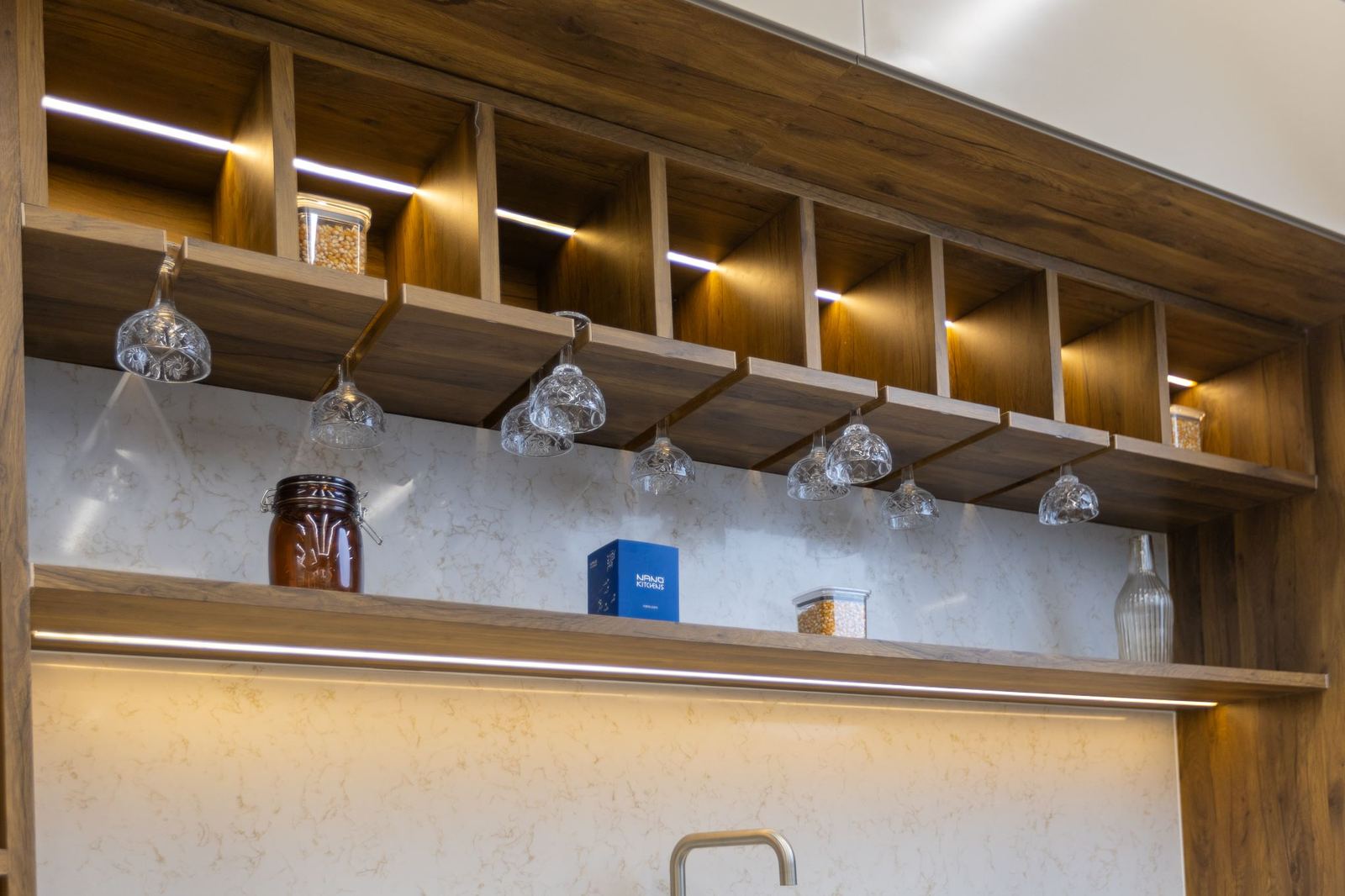
- Accent Lighting: Subtle lighting that defines the design aesthetics and details of your kitchen cabinets. Examples include low-voltage LED strips under toe-kicks to create a floating cabinet effect, or internal cabinet lighting behind glass doors.
2. Light Output Mathematics: Lumens vs. Lux
Buying light bulbs based solely on electricity consumption in Watts is a common error. In modern lighting design, we use specific photometric units to calculate light requirements:
- Lumen (lm): The total amount of light emitted by a light source in all directions.
- Lux (lx): The intensity of light falling on a specific surface area. One Lux is equal to one Lumen per square meter ($1\text{ lx} = 1\text{ lm/m}^2$).
The core formula to calculate the required light output is:
Required Lumens = Recommended Lux × Target Area (m²)
3. Recommended Lux Levels for Kitchen Work Zones
International architectural standards, such as those from the Illuminating Engineering Society (IES), define specific target illumination values for kitchen areas to ensure visual comfort and reduce eye strain:
| Kitchen Work Zone | Recommended Illumination (Lux) | Functional Objective |
|---|---|---|
| Prep Countertops & Chopping Boards | 300 - 500 Lux | Clear, high-contrast visibility for safe knife handling and precise measurements. |
| Kitchen Sink & Dishwashing Area | 300 Lux | Easy inspection of dishes to identify remaining food residues or grease. |
| Stove & Cooktop Area | 300 Lux | Monitoring cooking stages, boiling points, and color changes in ingredients. |
| Pantry Storage & General Walkways | 150 - 200 Lux | Safe passage and clear legibility of expiration dates and ingredients labels. |
Calculation Example: If your kitchen island dedicated to food prep is 3 square meters (e.g., 3 meters long by 1 meter wide), and you want to achieve a target task brightness of 400 Lux, the calculation is:
Required Lumens = 400 Lux × 3 m² = 1200 Lumens.
To achieve this, choose pendant lights or LED strips that emit a combined total of 1200 Lumens over the island surface.
4. The Importance of Color Rendering Index (CRI) in Food Prep
Color Rendering Index (CRI) is a vital metric that measures how accurately a light source reveals the true colors of objects compared to natural sunlight. It is scored on a scale from 0 to 100.
In a kitchen, using light sources with a CRI of 90+ is highly recommended. Low CRI lighting (80 or below) makes food, particularly fresh produce and raw meats, look dull, gray, or artificially greenish. This does not just detract from visual appeal; it is a safety risk because it is harder to notice discoloration in meat or poultry, which indicates undercooking or spoilage. At Nano, we construct our kitchen lighting layouts exclusively with CRI 90+ LEDs to guarantee natural color rendering.
5. Kelvin Color Temperatures: Visual & Psychological Impact
Color temperature is measured in Kelvin (K). Choosing the right Kelvin rating is important to set the appropriate mood and support work productivity:
- Warm White (3000K): A soft, slightly yellow light that creates a cozy, inviting atmosphere. Excellent for open-concept kitchens, dining nooks, and seating areas.
- Natural White (4000K): Simulates midday natural daylight. It is the ideal architectural choice for task lighting above prep areas and sinks because it maximizes clarity without causing eye fatigue.
- Cool White (5000K to 6500K): A crisp, bluish light that maximizes focus and visibility. Used primarily in commercial kitchens and medical environments, but can feel overly clinical and harsh in residential homes.
6. Heat Dissipation in Aluminum Channels
While LEDs generate minimal heat in their light beam, the microscopic semiconductor chips at the back of the strip generate substantial heat during operation. Without proper heat dissipation, this thermal build-up degrades the LED phosphors, reducing brightness and changing color output, and can burn out the strip within months.
To prevent this, Nano mounts all under-cabinet LED strips inside extruded aluminum profiles. The aluminum serves as a highly efficient heat sink, drawing heat away from the LED chips and venting it into the air. This thermal management prolongs the operating life of the LEDs to more than 50,000 continuous hours without fading.
7. Common Kitchen Lighting Errors to Avoid
- Relying on a Single Ceiling Source: This places the light behind you while working, casting your shadow onto the prep boards and sink.
- Glaring Surface Reflections (Glare): Placing high-output downlights directly above glossy quartz or polished stone countertops, causing sharp reflections that strain the eyes.
- Ignoring Deep Drawer Lighting: Forgetting to illuminate the inside of deep cabinets and drawers. We recommend automatic drawer-activated LED sensors to solve this.
- Single-Switch Controls: Wiring all kitchen lights to a single switch. It is better to split task, ambient, and accent lighting onto separate switches to control the room's mood.
8. Schedule Your Technical Consultation
At Nano Kitchens, we understand that premium kitchen design requires a seamless integration of cabinetry architecture and advanced lighting engineering. You can experience our integrated LED systems firsthand at our showrooms in:
- Riyadh Showrooms (Takhassusi St & Al-Taawun District)
- Khobar & Eastern Province Showroom
- Buraidah Showroom (Al-Qassim)
Book your free technical design and measurement consultation today through our Appointment Booking Page to plan your kitchen lighting layout with our engineering team.
Frequently Asked Questions
What is the best light level for kitchen countertops?
Prep countertops and food preparation areas require a target brightness of 300 to 500 Lux to ensure visual safety while handling knives and measuring ingredients.
Why does fresh food look grey under some kitchen lights?
This is caused by a low Color Rendering Index (CRI) rating. Standard light bulbs often have a CRI rating of 80 or less, which fails to show natural colors accurately.
Do under-cabinet LED lights heat up the cabinets?
LEDs emit very little heat compared to old halogen bulbs, provided they are installed in aluminum channels to dissipate heat safely away from cabinets and food items.
What color temperature is best for kitchen work zones?
Natural White (4000K) is recommended for work surfaces and prep zones, while Warm White (3000K) is ideal for ambient areas and dining tables.
Academic & Architectural References
- Illuminating Engineering Society (IES) Lighting Handbook
- The Society of Light and Lighting (CIBSE SLL): Code for Lighting
- National Kitchen & Bath Association: Professional Lighting Planning Guide
- US Energy Star: Understanding Color Rendering Index (CRI)
- ASHRAE Standards for Energy Efficient Design of New Buildings