
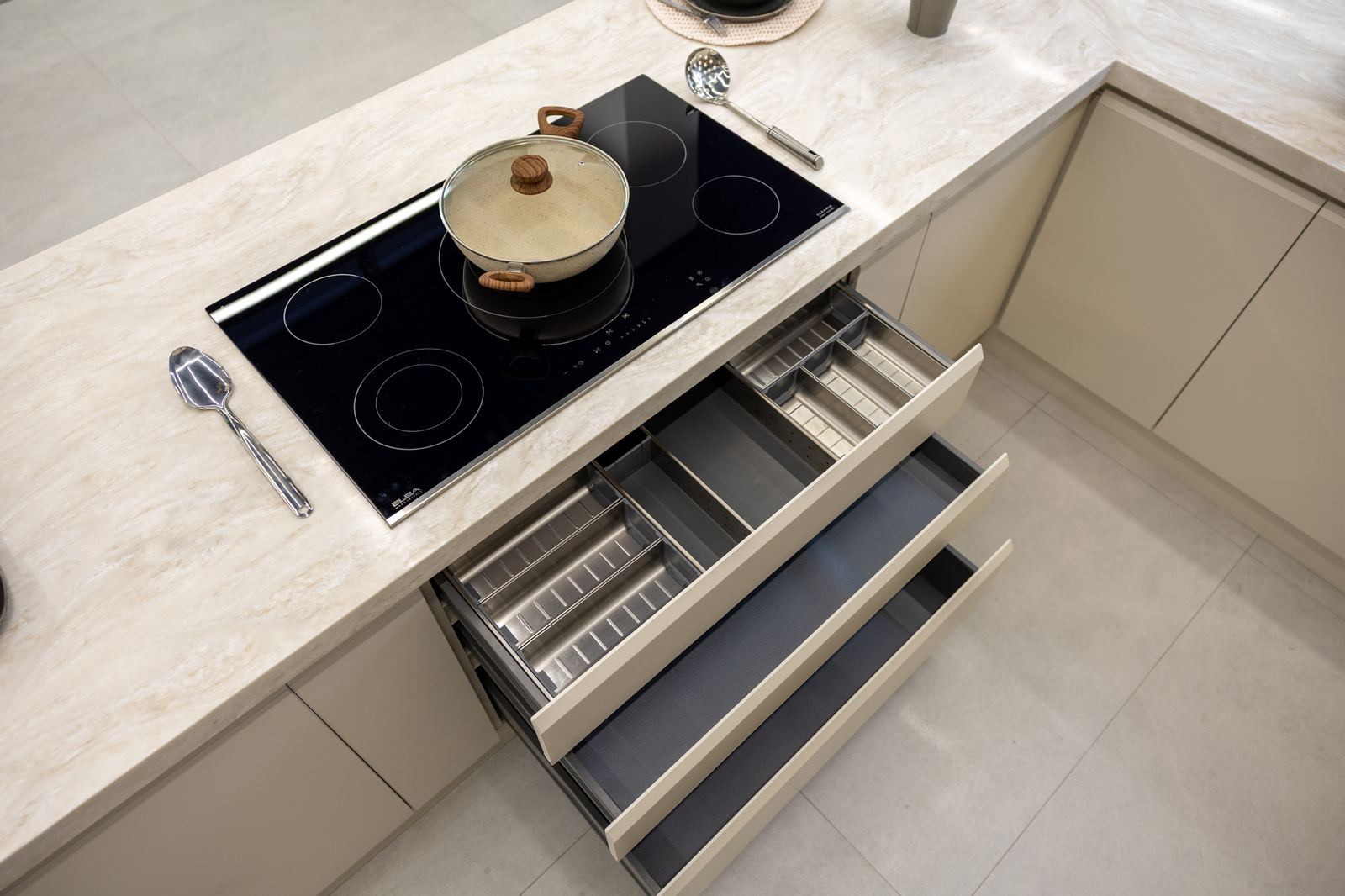
The term kitchen accessories might suggest optional add-ons, but in practical design, they form the internal system that makes the kitchen function efficiently. A deep drawer is not just a box; it is the ideal spot for heavy pots if positioned near the cooktop. A tall larder unit is not just a pretty shelf; it is the perfect solution for viewing dry provisions at a glance. A kitchen corner is not dead space; it can be transformed into highly functional storage if the mechanical system is chosen wisely.
A common issue with online advice is that it lists accessory names or photos without explaining when to use them, when to avoid them, and how they relate to the family's workflow. This guide builds storage decisions around daily usage, drawing on global guidelines for kitchen planning, food safety, ventilation, and accessibility, then translates them for contemporary Saudi households.
Quick Summary: How to Choose Kitchen Accessories?
Select accessories based on the items you intend to store and where you will use them, rather than the number of pieces. Keep daily-use items within the zone between your waist and shoulders. Place pots near the cooking area, cutting tools near the prep surface, cleaning supplies under the sink (isolated from food), and dry goods in a visible area that facilitates food rotation. Do not spend money on complex mechanisms if a simple shelf or deep drawer can do the job.
1. Vertical Reach Ergonomic Zones (Reach Zones)
Universal design guides like the AARP HomeFit Guide emphasize that a comfortable home must serve residents of different ages and physical capabilities. In kitchen engineering, storage planning is not just horizontal; it is organized vertically into three main reach zones based on usage frequency and physical effort:
- The Golden Zone (Hot Zone): The space between waist and shoulder height (75 cm to 140 cm from the floor). This is the ideal spot for storing high-frequency, daily-use items such as plates, spices, knives, immediate food items, and daily coffee cups.
- The Silver Zone (Warm Zone): The space requiring slight bending or reaching upward (40-75 cm and 140-180 cm). This is suitable for medium-frequency storage, such as heavy pots and pans at the bottom, and guest dinnerware or serving bowls at the top.
- The Bronze Zone (Cold Zone): The space very close to the floor or near the ceiling (below 40 cm and above 180 cm). This is reserved for seasonal or low-frequency items (such as large guest platters, holiday baking appliances, bulk dry goods, or seasonal blenders) because accessing them requires significant bending or a step stool.
2. Deep Drawers: When Are They Better Than Shelves?
Deep drawers are perfect for pots, pans, storage containers, and small appliances if the weight and motion profile are correct. Their primary benefit is that the user pulls the drawer out and views the contents from above, rather than bending down and searching the back of a deep shelf. However, they require careful planning: the correct depth, proper internal dividers, and proximity to the work area. A pot drawer should be near the stove, and a container drawer is best placed near the food prep zone or the refrigerator.
3. Drawer Load Capacities: Technical Differences Between 30 kg and 50 kg to 70 kg
Many homeowners make the mistake of storing large sacks of rice and flour, or heavy cast-iron pots, in standard drawers, leading to bent runners, sagging drawer bases, and early failure. Drawer slides are classified by weight capacity:
- Standard Runners (30 kg): Designed to carry up to 30 kg (including the weight of the drawer box and front panel). Perfect for cutlery drawers, knife organizers, light plates, and everyday small utensils.
- Heavy-Duty Runners (50 kg to 70 kg): Specially engineered for heavy cookware, glassware, and bulk storage. At Nano Kitchens, we build heavy-duty aluminum chassis compatible with high-load soft-close slide systems to prevent slamming and ensure smooth operation even under maximum load.
4. Tall Larders: A Powerful Solution When Organized, Not Just a High Cabinet
A tall larder unit is excellent for families who store bulk provisions or want to see items quickly. However, without partition systems, it can quickly become an unorganized mess. Categorize your items: grains and canned goods, oils and condiments, guest service items, or small appliances. Never mix food with cleaning chemicals, and avoid placing very heavy objects on high shelves where lifting them poses a safety risk.
Food safety guidelines from the FDA stress the importance of dry storage temperature and tracking expiration dates. In a well-designed kitchen, a clear larder (utilizing pull-out drawers or linked tandem baskets) helps you see and rotate stock, ensuring that older items are used first rather than being forgotten in the dark corners of a deep cabinet.
5. Kitchen Corners: Don't Let Them Become Dead Storage
Corner cabinets are notorious for wasting space. In L-shaped or U-shaped layouts, the corner can become a deep, dark cavern that is difficult to access. Traditional fixed shelves turn this space into a graveyard for neglected cookware. Modern mechanical hardware, however, provides full access to corner contents without bending down or climbing inside the cabinet.
6. Corner Solutions Comparison: Lemans vs. Magic Corner vs. Lazy Susan
To solve the dead corner problem, three main mechanical systems are widely used. The table below compares their engineering and practical characteristics to help you make the right choice for your needs and budget:
| System | Space Efficiency | Weight Capacity | Cleaning & Maintenance |
|---|---|---|---|
| LeMans System | Very High (shelves swing independently and fully out of the cabinet in a smooth curve) | High (up to 25 kg per shelf independently) | Very Easy (smooth, non-overlapping shelves that can be easily wiped down) |
| Magic Corner | High (rectangular baskets slide forward and sideways upon opening) | Medium to High (15-20 kg for inner baskets) | Moderate (complex frame structure makes cleaning tight metal junctions slightly harder) |
| Lazy Susan (Rotating Carousel) | Medium (circular shape leaves the outer corners of the cabinet empty) | Low (typically 10-12 kg maximum for the central axis) | Difficult (if items fall off the back of the carousel, they are hard to retrieve) |
When selecting a corner accessory, do not look only at the complex movements in the showroom. Always ask about the maximum weight it can support, how easy it is to wipe clean of kitchen grease, and its mechanical durability over time.
7. The Under-Sink Zone: Cleaning, Waste, and Towels Together
The under-sink area requires dedicated planning due to water lines, drainage, and dampness. Keep your cleaning chemicals separate and secure, far away from food items. If the dishwasher is located next to the sink, think about where you will store clean dishes: are the cupboards or drawers near enough? Will you have to walk across the kitchen every time you empty the dishwasher?
The under-sink cabinet is also the standard spot for an integrated trash bin. Ensure it is easy to reach and simple to clean. An accessory that is difficult to sanitize will become a hygiene hazard in a damp, high-use environment.
8. Coffee Corner & Small Appliances: Don't Let Them Steal Your Countertop
Most modern Saudi homes require a dedicated setup for coffee machines, kettles, blenders, air fryers, and food processors. If these are not planned for, they will crowd the countertop and limit your prep space. The solution is not always hiding every machine; it is identifying the ones you use daily and giving them a designated spot with nearby outlets and an easy-to-clean surface.
You can integrate a coffee corner within your kitchen layout with upper cabinetry for cups, drawers for pods, and a small countertop section near electrical outlets. See our Coffee Corner Kitchen Design Guide if this is an essential part of your routine.
9. Ventilation & Storage: Why Grease and Odors Impact Cabinets
Ventilation is not just about the range hood; it directly impacts cabinet cleanliness. The US EPA notes that cooking releases moisture, odors, and indoor air pollutants, and that operating a venting range hood helps manage these exposures. In kitchens with poor ventilation, a greasy, sticky film builds up on nearby cabinets, making drawers and shelves much harder to clean.
This is why you should never plan spice or dish storage in isolation from the range hood. Cabinets close to the stove must use easy-clean finishes and structures that tolerate grease and humidity without becoming hard to maintain. For details, read our Kitchen Ventilation & Range Hood Guide.
10. Accessory Selection Checklist Before Finalizing Design
- Utility: Does this accessory solve a daily storage challenge, or is it just for show?
- Proximity: Is it close to where the stored items will actually be used?
- Accessibility: Can you reach the contents without excessive bending or needing a step stool?
- Cleanability: Is it easy to wipe down and clear of crumbs or grease?
- Weight capacity: Does it support the weight of the items intended for it?
- Maintenance: Is the mechanical action simple enough for long-term daily use?
- Flexibility: Can the internal dividers be adjusted if your family's needs change?
- Safety: Are knives and cleaning chemicals kept out of reach of young children?
11. Common Mistakes in Organizing Kitchen Cabinets
- Buying too many storage containers or accessories before defining what will be stored.
- Storing heavy bulk items (like rice bags and cast-iron cookware) in high upper cabinets.
- Mixing cleaning chemicals and sanitizers in the same drawer as food or dinnerware.
- Leaving deep corner cabinets with fixed shelves, making the back inaccessible.
- Placing spice racks or oils in open shelves directly above the cooktop (heat degrades quality).
- Allocating a large countertop area for small appliances without installing enough electrical sockets.
- Forgetting to allocate vertical storage for large baking trays and tall serving platters.
12. Balancing Storage Needs and Your Kitchen Budget
Internal accessories can add significantly to the cost of a custom kitchen. It is best to prioritize them by impact. Begin with high-frequency zones: deep cookware drawers with heavy-duty slides, daily prep drawer dividers, the under-sink pull-out, and the pantry. Add complex corner pull-outs or tall larders only if budget allows. Do not spend money on a rarely-used corner mechanism if it means using low-quality sliders on your main cutlery drawer.
When comparing ready-made cabinets to a custom kitchen, internal storage flexibility is a key differentiator. A custom design allows you to position drawers and vertical dividers exactly where you need them, whereas ready-made units impose fixed dimensions that lead to wasted space. Read our Ready-Made vs. Custom Kitchens Comparison before making your choice.
13. What to Discuss with Your Designer During a Showroom Visit
When you visit Nano Kitchens Showrooms, do not ask only about the price per meter. Request a detailed walkthrough of the internal storage zones. Where will the pots go? Where will everyday plates be kept? Where is the trash bin housed? Where will small appliances sit? How does the corner mechanism pull out? These questions help the designer respond to your daily use.
You can schedule a design consultation and measurement discussion directly through our Appointment Booking Page. You can also read our localized city guides to learn about delivery, installation, and showroom details in your region:
Frequently Asked Questions About Kitchen Accessories
Are kitchen cabinet organizers necessary?
Not all of them. What is necessary is whatever resolves a daily functional bottleneck: access to heavy pans, pantry organization to prevent waste, separating cleaning chemicals, or utilizing a dead corner. An accessory that does not serve a clear purpose adds cost without value.
Where is the best place to store spices?
Keep spices in a dedicated drawer insert or pull-out organizer near the prep or cooking zone. However, keep them away from direct oven heat and steam, which degrade spice quality and shorten shelf life.
Are drawers better than traditional shelves?
Drawers are far superior for base cabinets because they expose the entire depth of the cabinet from above, eliminating the need to bend down. Shelves remain highly suitable for upper cabinets and for storing light, low-use items.
How should cleaning chemicals be stored safely?
Designate a separate compartment under the sink or an isolated pull-out rack away from food and cookware. We recommend installing child-safety locks if young children are in the home.
What is the most important factor in a tall pantry larder?
Visibility and ease of retrieval. A deep, dark pantry with fixed shelves makes it hard to see what you have, leading to duplicated purchases and expired food items. Pull-out drawers or linked baskets solve this issue completely.
Step-by-Step Storage Planning Action Plan
- Take photos of your current kitchen contents or write a list of what you own.
- Mark items and tools that you use on a daily basis.
- Separate food and dry provisions from cleaning chemicals and appliances.
- Identify heavy items (pans, cast-iron pots) that require heavy-duty drawer slides.
- Decide which small appliances must stay on the counter and which should be stored away.
- Write down the main pain points in your current kitchen (dead corners, high shelves, cluttered surfaces).
- Bring this plan to your nearest Nano Showroom and work with the designer to configure your internal cabinets around it.
Academic & Professional References
- National Kitchen & Bath Association: Kitchen & Bath Planning Guidelines
- NKBA Kitchen Planning Guidelines PDF
- AARP HomeFit Guide: Universal home design and safety guidance
- FDA: Food Safety in Your Kitchen
- FDA: Are You Storing Food Safely?
- U.S. EPA: Sources of Indoor Particulate Matter - Cooking
- NFPA: Cooking Safety Tips
From planning to a suitable choice
Connect these decisions to Integrated kitchen solutions, and identify your preferred materials and appliances when discussing the layout.