
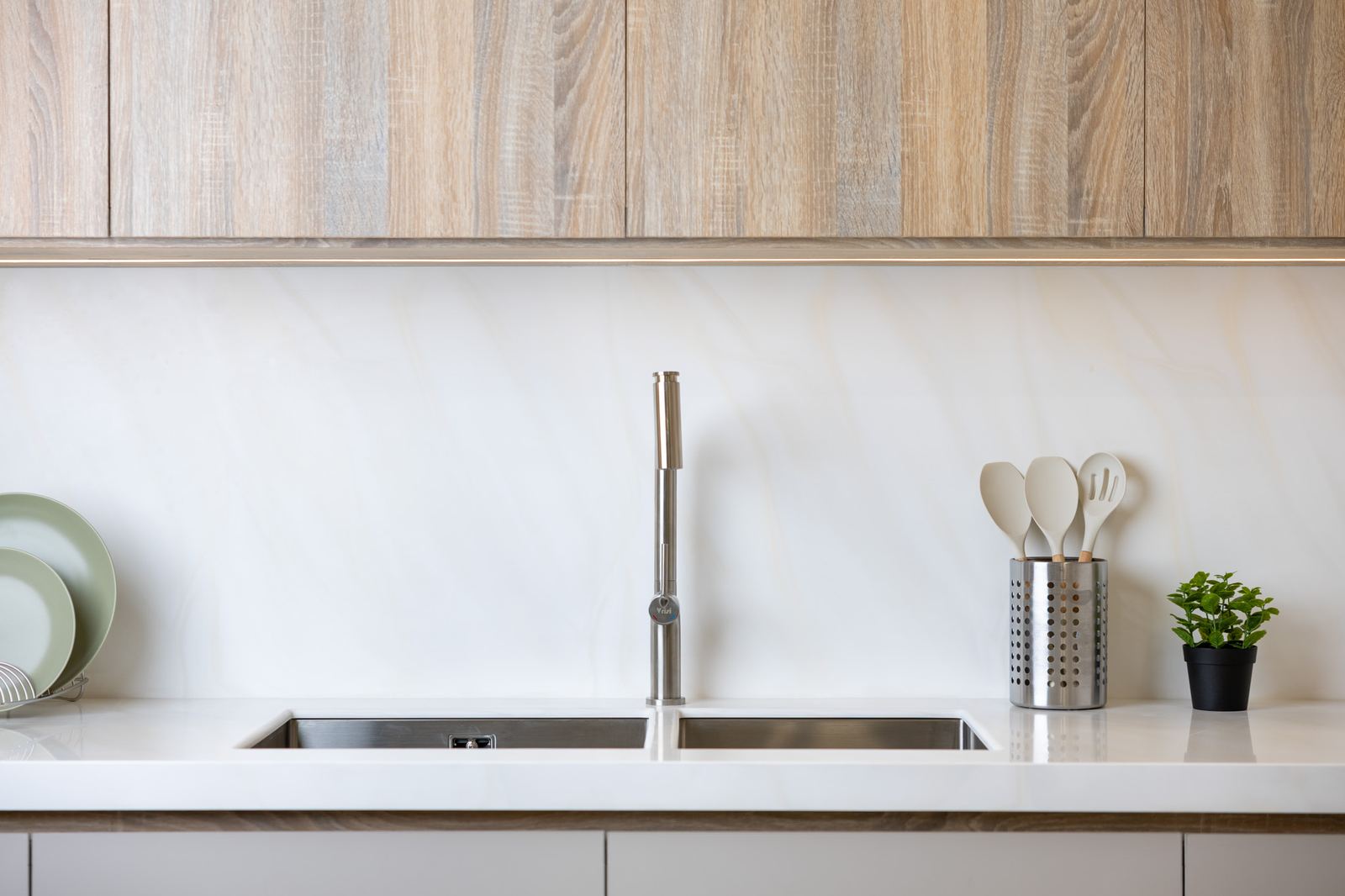
What is solid surface?
Solid surface, called «رخام صناعي» (manufactured marble) in the Saudi market, is a cast sheet of resin (acrylic, polyester or a blend) with mineral fillers, mainly aluminum trihydrate. Color and pattern run through the full thickness, so surface scratches can be sanded out, pieces can be bonded with a matching adhesive for near-invisible seams, and a sink can be formed in the same material as the worktop.
It is neither natural marble nor quartz; quartz is an engineered stone with a high quartz content and different properties. For the other materials see the kitchen worktop guide.
Quick comparison with other worktops
| Property | Solid surface | Quartz | Porcelain | Natural marble and granite |
|---|---|---|---|---|
| Seams | Near invisible | Visible | Visible | Visible |
| Scratch repair | Sanding and polishing | Difficult | Difficult | Specialist polishing |
| Direct heat | Lowest tolerance; always use a trivet | Use a trivet; resin can be affected | High tolerance | Good, with a risk of thermal shock |
| Porosity | Non-porous | Low | Very low | Porous; needs sealing |
| Sink in the same material | Possible and seamless | Limited | Limited | Limited |
The table is general; always check the data sheet of the specific product, as formulations vary between manufacturers.
Full-body or veneer? How to check yourself
Some worktops are offered where only the top layer is solid surface material over a base of other materials, locally called «قشرة» (veneer) or «رش» (spray). From above they look like a full-body top, but the thin layer can separate or crack and does not allow the repeated sanding that makes solid surface repairable.
- Check the cut edge: look at the edge of a cut sample or the sink cut-out. In full-body material the color is consistent through the section; in a veneer a different or grainy material shows under a thin layer.
- Look underneath: the underside of a full-body sheet is the same material.
- Ask about the product: its name, type and thickness, and its data sheet if available.
Why does solid surface crack?
Direct heat
Hot pots, appliances that release heat from below or behind such as some air fryers and countertop ovens, and a cooktop fitted without proper insulation around its cut-out. Prevention: a trivet under hot pans and appliances, and a cooktop cut-out and clearances made to both the worktop and cooktop manufacturers' instructions.
Sharp corners in cut-outs
A square inside corner in a cooktop or sink cut-out concentrates stress, and cracks often start there. Prevention: ask for radiused inside corners on cut-outs and rounded ends on overhangs and outside corners; they are also easier to clean and less likely to chip on impact.
Insufficient support
Common solid surface sheets are relatively thin and need supports or a flat base at spacings set by the manufacturer, especially around the sink, cut-outs and island seating overhangs. Prevention: ask about the support type and spacing and how overhangs are supported.
Fixing onto a material affected by water
If the worktop is fixed on a material that absorbs water, it can swell with damp, lift and stress the top, and also cause smells. Prevention: supports made of a material unaffected by water, with a suitable expansion gap at walls.
The sink and the wall behind the cooktop
A sink cast in the same material gives a continuous, easy-to-clean surface but needs care with boiling water and hot pans. An undermount stainless steel sink is another option that tolerates heat. For the wall behind a gas hob, choose a heat-resistant material, and follow the worktop manufacturer's clearances if you want to clad it in solid surface. See the kitchen sink guide.
Finish and daily care
- Choosing a finish: matt or satin hides daily scratches better; gloss shows them sooner and needs more care, especially in dark colors.
- Daily: water, mild soap and a soft cloth, then dry.
- Stains: a non-abrasive cream cleaner as the manufacturer recommends.
- Light scratches: on a matt finish they can be treated with a fine abrasive pad as the product guide describes; deep scratches and full refinishing are for a specialist.
- Avoid: strong solvents, cutting directly on the top, and hot pans or appliances without a trivet.
Questions to ask before approving the worktop
| Question | Why ask it? |
|---|---|
| What is the product name and thickness? Is it full-body? | To compare offers on a specific product |
| What finish and color, by sample code? | Affects how scratches show and color matching |
| How are cut-out corners and ends finished? | Radiused corners reduce cracking |
| What supports are used and at what spacing? | Support decides how stable the top is |
| How is the cooktop cut-out treated? | The heat zone is the most sensitive area |
| What sink type and mounting? | Affects cleaning and heat tolerance |
Choosing the worktop with a Nano kitchen
When you design your kitchen at Nano Kitchens showrooms, ask the designer for the available worktop samples and compare their specifications with this list. To match the worktop with the cabinets, browse Nano kitchen designs.
Solid surface FAQ
Is solid surface heat resistant?
It handles normal use, but tolerates direct heat less than porcelain and granite, so use a trivet for hot pans and heat-producing appliances.
How can I tell full-body solid surface from a veneer?
Check the section at a sample edge or the sink cut-out: full-body material has consistent color through its thickness. You can also ask for the product name and thickness.
Can solid surface be repaired?
Yes. Surface scratches can be sanded out, and many cracks and breaks can be bonded with matching material by a specialist, with results depending on color and pattern.
Which is better, solid surface or quartz?
Each has an advantage: solid surface allows near-invisible seams and easier repair, while quartz resists scratches better. The choice depends on how you use the kitchen and your budget.