
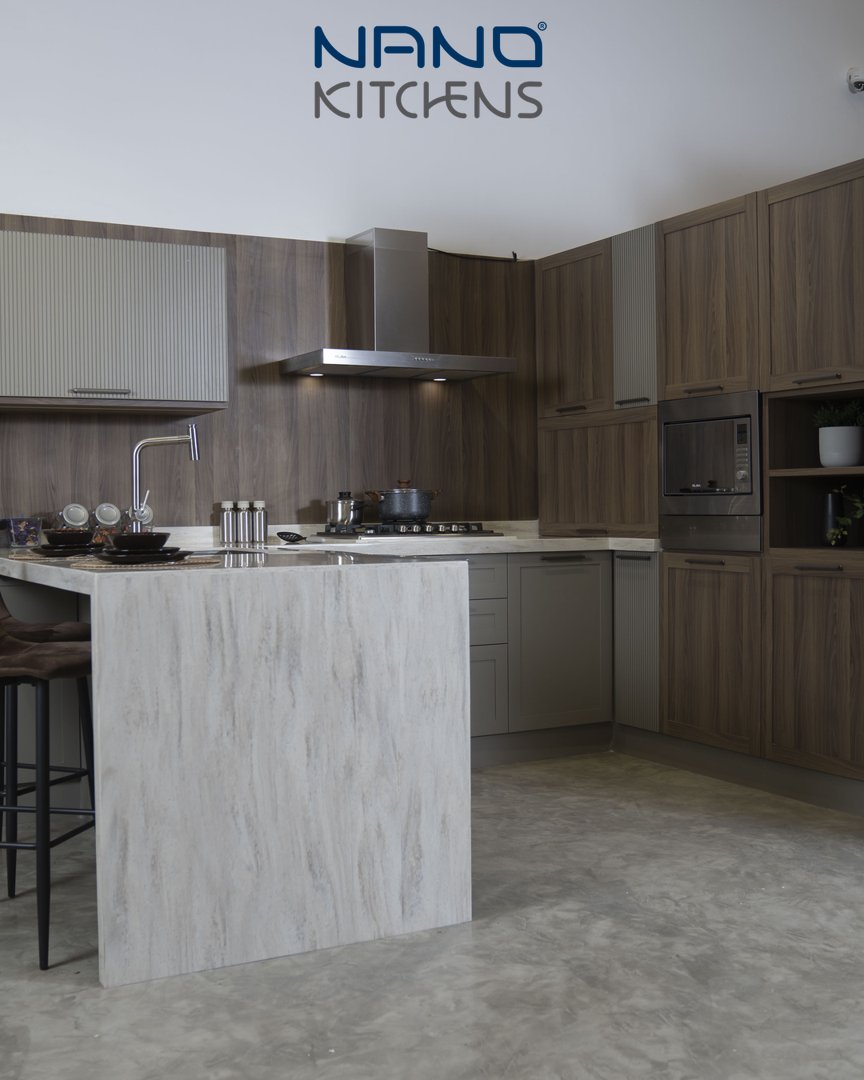
Most design guides start with visuals: cabinet colors, kitchen island shapes, or the word "modern." While appealing, these choices are not enough for a kitchen meant to serve a family for decades. True planning starts with the questions behind the scenes: How many people cook? Is cooking daily or seasonal? Are there frequent dinner parties? Where will appliances go? Does the range hood vent outdoors? And can you open drawers, the dishwasher, and the fridge without blocking traffic?
This guide is designed as a practical manual to prepare you before visiting Nano Kitchens showrooms and branches. Our goal is for you to arrive with a clear scope of your needs, not just random internet inspiration. The clearer your needs, the more precise and cost-effective your custom kitchen design will be.
Quick Summary for Direct Answers
The best way to plan a kitchen is to divide it into distinct work zones, testing workflows on a floor plan before choosing aesthetics. Measure your walls, windows, and doors, and mark your fridge, sink, range, oven, and dishwasher locations. Then, choose a layout: single-wall, L-shaped, U-shaped, open plan, or island. Avoid open layouts or islands unless traffic, privacy, and range hood venting allow it. Finally, audit your electrical outlets, plumbing, lighting, and ventilation ducts before cabinetry manufacturing begins.
1. Write Your Kitchen Needs Assessment
A needs assessment is a simple list outlining how your household uses the kitchen. It doesn't need architectural terms; just answer daily practical questions: Is the kitchen for heavy daily cooking or light preparation? Do you have house help cooking? Do children access the space? Do you need a dedicated coffee corner? Do you host large gatherings? Do you need extensive prep space for baking? Do you require bulk pantry storage?
These answers change the layout completely. A family cooking daily needs wide prep spaces, high-performance ventilation, and easy-access pull-out drawers. An open kitchen facing the living room demands extra care for odors, noise, and hidden layouts. A small apartment kitchen requires vertical storage optimization to avoid blocking traffic. If you're not sure where to start, read our family kitchen planning guide for Saudi homes and bring your list to the showroom.
2. Crucial Dimensions to Collect Before Your Showroom Visit
Measuring is more than wall length. You need a complete dimensional map of the room: wall lengths, ceiling height, door locations, door swing directions, window locations, water heater placement, plumbing points, drainage points, electrical outlets, range hood vents, and structural pillars or columns. Take clear photos of all walls from multiple angles, along with close-ups of plumbing and electrical outlets.
If your home is under construction or renovation, this is the perfect time to plan. You can easily adjust electrical outlets, set up range hood ducts, and install under-cabinet lighting. If you start planning after finishes are complete, you may face uncomfortable compromises, such as poorly placed appliances, ductless hoods, or dark countertops.
Standard kitchen dimensions table
| Item | Common size | Note |
|---|---|---|
| Worktop height | 85–90 cm | Adjust to the height of the people using the kitchen |
| Base cabinet depth | 60 cm (worktop 60–65 cm) | Suits most built-in appliances |
| Wall cabinet height | 70–90 cm, or up to the ceiling | Running to the ceiling stops dust collecting on top |
| Wall cabinet depth | 30–35 cm | Deeper units get in the way at the worktop |
| Worktop to wall units | 50–60 cm | Over the hob follow the hood instructions, often 65–75 cm for gas |
| Tall unit height | 210–240 cm | For oven, microwave, pantry and integrated fridge |
| Common unit widths | 30, 40, 45, 60, 80, 90 cm | The sink unit is usually 80–90 cm |
| Landing space beside the hob | At least 30–40 cm each side | For setting pans down safely |
| Work aisle between two runs | 107 cm for one cook, 122 cm for two | 90 cm minimum for a walkway |
These are common planning guidelines; final dimensions are set after measuring your site and appliances. For island dimensions see the kitchen island guide.
3. Think Work Zones, Not Just the Work Triangle
Traditional guides focus on the work triangle between the fridge, sink, and stove. While useful, this concept is outdated for modern layouts. It is better to organize your space into five functional zones: food storage (pantry/fridge), prep zone (utensils/boards), cooking zone (stove/oven), cleaning zone (sink/dishwasher/waste bin), and serving zone (coffee corner/serving counter). When zones are clear, arranging cabinets becomes intuitive.
For example, knives and cutting boards should be in drawers right under your prep counter, not across the room. Pots and pans belong near the stove. Cleaning products must be separated from food storage. Cups and espresso tools should sit near the coffee machine or serving area. These details make daily kitchen work seamless.
4. Choose Your Layout Based on Space, Not Photos
Five layouts dominate Saudi homes: single-wall, L-shaped, U-shaped, open plan, and island. Each has a specific use case. Single-wall layouts suit apartments and narrow corridors, requiring strong vertical storage. L-shaped layouts offer excellent traffic flow and space for a dining table. U-shaped layouts maximize storage and counter space but can feel tight in narrow rooms. Open layouts create visual space but require strong ventilation and neat designs. Islands are excellent when they add function without blocking pathways.
To compare layouts, refer to our kitchen layout types guide. If you are considering an island, read our kitchen island guide for Saudi homes before finalizing your design.
5. When to Choose an Open (American) Layout?
An open kitchen is more than removing a wall; it impacts privacy, acoustics, cooking odors, and living room aesthetics. Open layouts work well when the kitchen is kept neat daily, ventilation is high-performance, and there is a plan to hide clutter. If your household does heavy daily cooking with spices and oils, a closed layout, a semi-open design, or a sliding glass partition is a much better option.
In Saudi homes, the practical solution is often a middle ground: a serving hatch, a peninsula, a glass partition, or an open preparation kitchen combined with a closed service (dirty) kitchen. Read our American open kitchen guide to weigh the pros and cons before making your decision.
6. Show Kitchen vs. Service (Dirty) Kitchen in Saudi Villas
In modern Saudi villas, the debate is no longer just open vs. closed. The standard practical layout is splitting the space into two: a show kitchen (open to the living area) for light prep, breakfast, and coffee, and a closed service kitchen (dirty kitchen) for heavy cooking and frying. The show kitchen focuses on refined aesthetics, cleanable finishes, and built-in appliances that align with the living area. The service kitchen must be designed for durability, water resistance, and heat resilience. Double-walled aluminum cabinet structures are a practical option here because they withstand daily heavy cleaning and allow grease to be wiped off without degrading the cabinets.
7. The Kitchen Island: Workhorse or Traffic Jam?
A kitchen island adds value when it performs a specific function: prep space, deep drawers, casual seating, a sink, or a serving counter. However, it is a costly mistake in a room that is too small. Don't test an island on an empty floor plan; imagine opening a deep drawer, loading the dishwasher, or standing at the sink while someone passes behind you. If these scenarios feel tight, skip the island or reduce its size.
Avoid trying to make the island do everything. An island with a stove, sink, seating, and storage requires complex plumbing, electrical, and venting pathways. In most homes, the best configuration is keeping the island for prep, storage, and seating, while keeping heavy cooking and washing along the main walls.
8. Small Kitchens: Hidden Decisions Make the Difference
In a small kitchen, there is no room for error. Every centimeter must serve a purpose. Vertical storage, internal drawer dividers, ceiling-height cabinets, neutral colors, under-cabinet lighting, and integrated appliances make small rooms feel larger. The most critical decision is avoiding items that look beautiful but consume traffic space, like unnecessary islands or dining tables.
A small kitchen doesn't mean compromising on quality; it means prioritizing. Keep daily essentials within arm's reach and store seasonal items in top cabinets. Read our small kitchen design guide for detailed layout solutions.
9. Plan Ventilation from Day One
Environmental agencies like the U.S. EPA emphasize that cooking adds moisture, grease, and indoor air pollutants, making ducted range hoods essential for home air quality. The Home Ventilating Institute (HVI) notes that range hood performance depends on airflow (CFM/m³/h), noise levels (sones), placement, and duct paths.
In your plan, ask early: Where is the stove? Is the range hood directly above it? Is there a straight duct path to the outside? Can the duct be concealed inside cabinets or the ceiling? Placing a range in an island complicates venting. If ignored, you may end up with a beautiful kitchen that traps grease and cooking odors in your living area. Read more in our kitchen range hood guide.
10. Electrical and Plumbing Outlets: The Details That Matter
Kitchen electrical plans require more than random sockets. You need dedicated circuits for heavy appliances (fridge, oven, dishwasher), accessible outlets for small appliances (blenders, kettles), under-cabinet lighting, and island power points. Select your appliances before cabinet design: their dimensions, power ratings, and ventilation clearances must match the cabinet layouts.
Plumbing layout determines your sink and dishwasher placement, which affects your under-sink storage. Changing drain pipes after finishing is extremely expensive. Keep plumbing and electrical layout integrated with your cabinetry design from the start.
11. Appliance Integration & Clearance Math (Built-In vs. Freestanding)
Buying appliances after designing cabinets or neglecting ventilation space around them is a common mistake. Built-in appliances (ovens, microwaves, dishwashers, integrated hoods) offer a sleek, flush look, but require dedicated cabinet ventilation channels and open backings to prevent heat buildup, along with precise millimeter-perfect cabinet sizing. Freestanding appliances (like double-door refrigerators) require at least 5 cm of clearance on the sides and back for proper airflow, and their door swings must be mapped so they do not block adjacent walkways or cabinets when opened.
12. Kitchen Lighting: Don't Rely on Ceiling Lights Alone
A functional kitchen requires three layers of lighting: ambient lighting for general visibility, task lighting directly over work surfaces (under-cabinet LED strips, island pendants), and accent lighting (toe-kick strips, glass cabinet interiors). Relying solely on ceiling spotlights is a mistake; when standing at the counter, your body casts a shadow over your prep space. Under-cabinet lighting solves this problem when planned early. Good lighting is also a safety requirement when handling knives and hot pans.
13. Storage Planning Starts with Your Items, Not Cabinets
Don't just ask how many cabinets you need. Ask what you need to store: large pots, frying pans, daily dishes, spices, dry pantry goods, cleaning supplies, small appliances, baking trays, and serving platters all require different storage solutions. Effective storage keeps items close to where they are used.
If storage is your focus, check our dedicated kitchen storage and accessories guide. It covers drawer layouts, corner pull-outs, tall pantries, and under-sink organization.
14. Kitchen Safety: Design Decisions First, Habits Second
Fire protection associations (like the NFPA) highlight cooking as the leading cause of home fires. In design, you can minimize risks with smart choices: keep curtains and flammable materials away from the stove, avoid placing the main prep counter in child traffic paths, provide strong task lighting, and leave landing space for hot pans near the stove. Ensure drawers and dishwashers do not block pathways when open to prevent trips and spills.
15. Common Budgeting Pitfalls in Kitchen Projects
Budgeting a kitchen requires balancing costs based on material lifespan. A common mistake is spending the entire budget on exotic countertop slabs and cabinet finishes while using cheap hinges, drawer runners, and thin cabinet structures. A beautiful facade will not last if cabinet doors sag or hinges rust due to humidity. Allocate your budget first to a water-resistant, rust-proof, and structural inner frame (like double-walled aluminum), followed by high-quality hardware with long warranties, and then select countertops and outer finishes with the remaining budget.
Checklist before visiting a kitchen showroom
- Write down each wall length, the ceiling height, door widths and the positions of windows and services.
- Photograph the kitchen from every angle, with close-ups of projections, columns and the hood opening.
- Choose the appliances, their sizes and door swings before the design.
- Define how you use the kitchen: daily cooking? frequent guests? a coffee corner? more than one cook?
- Rank budget priorities: better material, stronger drawers, a practical worktop, integrated appliances or storage solutions.
In a small kitchen, prioritize deep drawers and a tall pantry unit over more cupboards, choose light matte colors and under-cabinet lighting, and swap an island for a peninsula or an L layout if the aisle would fall below 90 cm.
16. What to Bring to Your Nano Showroom Visit
- Clear photos of your kitchen space from all angles.
- Wall dimensions, ceiling height, door and window placements.
- Locations of plumbing, drains, electrical outlets, and ventilation ducts.
- A list of appliance models and their dimensions.
- Inspiration photos of layouts and styles you like.
- Your household needs list (daily cooking, hosting, children, coffee corner, pantry).
- A balanced budget focusing on structural quality and hardware first.
Once you have this information, visit Nano Kitchens showrooms in Riyadh, Khobar, Dammam, Al-Ahsa, and Buraidah. For localized planning advice, refer to our city guides: Kitchens Riyadh, Kitchens Khobar, Kitchens Dammam, Kitchens Al-Ahsa & Hofuf, and Kitchens Buraidah.
Frequently Asked Questions
What is the first step in kitchen design?
The first step is defining how you will use the space and taking accurate measurements. After that, choose your layout, place key appliances, and plan your storage and ventilation. Selection of colors and finishes comes last.
Is an island suitable for every kitchen?
No. Islands require ample clearance around them for traffic and opening cabinet doors. In small or narrow kitchens, an L-shaped layout or a peninsula is a much better choice.
Are open-plan kitchens practical in Saudi Arabia?
They are practical if you have high-performance range hoods and do light cooking. For households with heavy daily cooking, a closed kitchen or a dual-kitchen setup (show kitchen + service kitchen) is highly recommended.
When should I decide on the range hood placement?
Ventilation and duct paths must be planned from day one, especially if your stove is placed on an island or far from an exterior wall.
Execution Checklist Before Ordering Your Kitchen
- Determine your household needs, cooking style, and hosting frequency.
- Measure and photograph your kitchen space.
- Choose a layout optimized for traffic flow, not just looks.
- Select your appliance models and confirm their dimensions.
- Plan ventilation ducts and range hood placement early.
- Verify electrical outlets, lighting points, and plumbing.
- Allocate storage based on your items and zones.
- Double-check door and drawer clearances on the floor plan.
- Visit your nearest Nano showroom with your layout, dimensions, and checklist.
References and Sources
- National Kitchen & Bath Association: Kitchen & Bath Planning Guidelines
- NKBA Kitchen Planning Guidelines PDF
- U.S. EPA: Remodeling Your Home and Indoor Air Quality - Kitchen Remodel Ventilation
- U.S. EPA: Sources of Indoor Particulate Matter - Cooking
- Home Ventilating Institute: Range Hoods, A Consumer Guide
- NFPA: Cooking Safety Tips
From planning to a suitable choice
Connect these decisions to Nano kitchen designs, and identify your preferred materials and appliances when discussing the layout.